
Your Flight Got Canceled? What Airlines Owe You
Selling flights is regulated differently in every market. From DOT rules in the US to EU261 passenger rights in Europe, here's how governments control who can sell you a ticket and what protections you get.
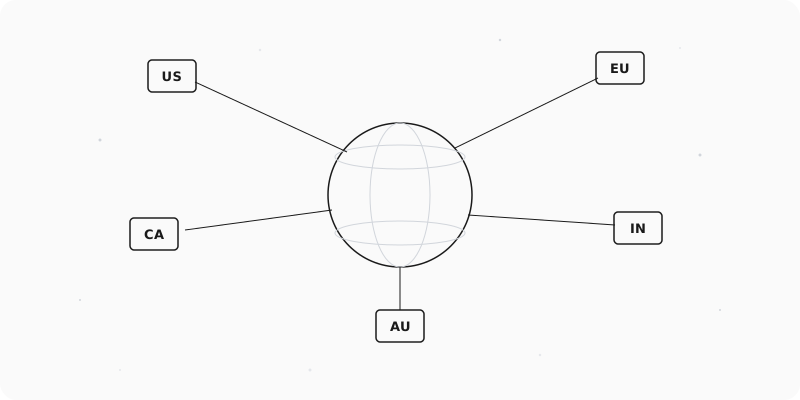
Selling airline tickets isn’t the same everywhere. Each country has its own rules about who can sell flights, what information must be disclosed, what happens when flights are canceled, and how your money is protected. If you’re building a flight booking platform — or just want to understand your rights as a traveler — these differences matter.
United States
Regulator: Department of Transportation (DOT)
The US has some of the most specific rules about how airfare must be displayed and sold:
Full-fare advertising — DOT requires that any advertised price must include all mandatory taxes and fees. No showing a $99 base fare and revealing $180 in taxes at checkout. The price you see must be the price you pay.
24-hour free cancellation — Airlines must allow a full refund if you cancel within 24 hours of booking, as long as the flight is at least seven days out. This applies to all tickets, including non-refundable ones.
Refund rules — As of 2024, DOT rules require airlines to issue automatic cash refunds (not vouchers) for canceled or significantly changed flights. “Significant change” includes departure time shifts of 3+ hours for domestic and 6+ hours for international.
Seller licensing — There’s no federal license to sell airline tickets in the US. However, sellers must be ARC-accredited to issue tickets through GDS channels. Some states require separate seller-of-travel registration (California, Florida, Washington, Hawaii, and others).
No price regulation — The US deregulated airfares in 1978. Airlines can charge whatever the market will bear. The government regulates transparency, not pricing.
European Union
Regulator: European Commission + national civil aviation authorities
The EU has the strongest passenger protection regime in the world:
EU261/2004 — The landmark regulation that entitles passengers to compensation for delays, cancellations, and denied boarding on flights departing from EU airports (any airline) or arriving in the EU (on EU-based airlines):
- 2+ hour delay on short flights: €250
- 3+ hour delay on medium flights: €400
- 4+ hour delay on long flights: €600
- Cancellation with less than 14 days notice: same compensation scale
- Denied boarding (overbooking): same scale plus rebooking or refund
Package Travel Directive — Travel sellers offering packages (flight + hotel) must provide financial protection (bonding, insurance, or trust accounts) so travelers can be refunded or repatriated if the seller goes bankrupt.
ATOL (UK) — Post-Brexit, the UK runs its own Air Travel Organiser’s Licence scheme. Any UK company selling flight packages must be ATOL-protected, with a visible ATOL certificate. Consumer money is protected through a central trust fund.
Price transparency — Similar to the US, the full price including taxes must be shown upfront. Optional extras (bags, seats) must be opt-in, not pre-selected.
Canada
Regulator: Canadian Transportation Agency (CTA)
Canada’s Air Passenger Protection Regulations (APPR) took effect in 2019:
- Denied boarding compensation: $900 CAD (large carriers)
- Delays 3-6 hours: $400 CAD; 6-9 hours: $700 CAD; 9+ hours: $1,000 CAD
- Lost baggage: up to $2,300 CAD
Travel agencies must be licensed provincially. Ontario (TICO), Quebec (OPC), and British Columbia (Consumer Protection BC) each have separate licensing and bonding requirements.
India
Regulator: Directorate General of Civil Aviation (DGCA)
India’s regulations focus on airline operations rather than third-party sellers:
- Airlines must refund canceled flights within 7 days
- Denied boarding compensation: up to ₹20,000 for domestic flights
- No comprehensive licensing regime for online travel agencies — the market is largely self-regulated for ticket resellers
- GST (Goods and Services Tax) of 5% on economy and 12% on business class applies to base fares
Australia
Regulator: Civil Aviation Safety Authority (CASA) + ACCC
Australia’s consumer guarantee laws apply to flight bookings:
- If a service isn’t provided as promised (canceled, significantly changed), the consumer is entitled to a remedy — refund, replacement, or compensation
- No EU261-style fixed compensation schedule, but the ACCC actively pursues airlines for misleading conduct
- Travel agents must hold a valid licence in most states, with trust account requirements for client funds
Key differences that matter
| US | EU | Canada | India | Australia | |
|---|---|---|---|---|---|
| Cancellation compensation | Refund only | €250-600 + refund | $400-1,000 CAD | Refund within 7 days | Consumer law remedy |
| 24-hour free cancel | Yes (7+ days out) | No EU-wide rule | No | No | No |
| Full-price display | Required | Required | Required | Required | Required |
| Seller licensing | ARC + state-level | National authority | Provincial | Limited | State-level |
| Overbooking protection | Voluntary/involuntary rules | €250-600 | $900 CAD | Up to ₹20,000 | Consumer law |
Why this matters for flight booking platforms
Building a platform that sells flights across borders means navigating all of these regimes simultaneously. The display rules, refund obligations, licensing requirements, and consumer protection standards vary by where the traveler is, where the flight departs, and where it arrives.
Sira is built to be transparent in every market — published fares, no hidden fees, clear refund policies. That’s not just our philosophy; in many jurisdictions, it’s the law. Search flights on Sira →
Ready to book?
Compare real-time fares across 100+ airlines. No hidden fees, no markup — just the lowest price available.
Search flights on Sira →