
The 26 Secret Price Tiers on Every Flight
Every flight has up to 26 invisible fare classes — letter codes that determine your price, refund rights, miles earned, and upgrade eligibility. Here's the system airlines don't explain.
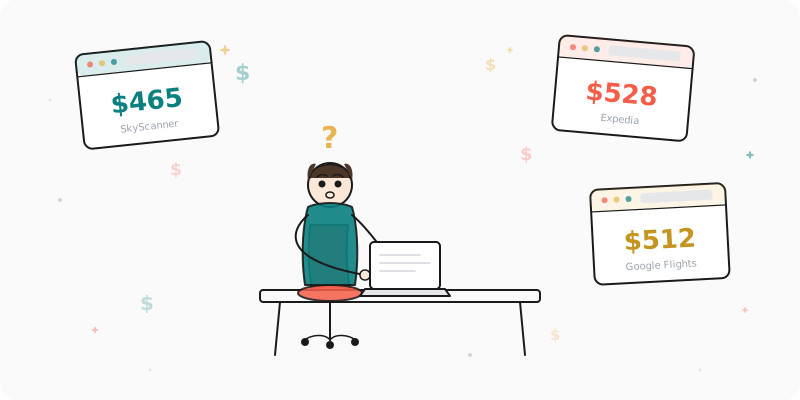
You and the person sitting next to you on a flight probably paid completely different prices for the same seat, on the same plane, on the same day. One of you might have paid $312. The other paid $847. Both of you are in economy. Neither of you did anything wrong. The difference? You were assigned different fare classes — and that single letter code determined everything.
The 26 fare classes hiding behind every ticket
Every flight doesn’t have one price. It has up to 26 different prices, each assigned a single-letter booking code. These codes are invisible to you — they never appear on your boarding pass or confirmation email — but they control your price, your refund rights, how many frequent flyer miles you earn, and whether you can upgrade.
Here’s how it actually breaks down on a typical US carrier:
First class
| Code | What it means |
|---|---|
| F | Full-fare first class. Fully refundable, changeable, earns 150% miles. The most expensive ticket on the plane. |
| A | Discounted first class. Still premium, but with some restrictions. Earns 150% miles. |
| P | First class sale or promotional fare. More restrictions, lower price. |
Business class
| Code | What it means |
|---|---|
| J | Full-fare business class. Fully refundable, fully flexible. Earns 150% miles. Corporate travelers live here. |
| C | Standard business class. Refundable with fee. Earns 125-150% miles. |
| D | Discounted business class. More restrictions, earns 100-125% miles. |
| I | Business class sale fare or consolidator class. Often non-refundable. |
Economy — full fare and flexible
| Code | What it means |
|---|---|
| Y | Full-fare economy. The most expensive economy ticket. Fully refundable, fully changeable, earns 100% miles. Almost nobody buys this voluntarily — it’s often 3-5x the cheapest economy fare on the same flight. |
| B | High economy. Refundable, flexible, earns 100% miles. Slightly cheaper than Y. |
| M | Mid-tier economy. Some flexibility, earns 100% miles. |
Economy — restricted
| Code | What it means |
|---|---|
| H | Restricted economy. Non-refundable or refundable with a fee. Earns 75-100% miles. |
| K | Restricted economy. Similar to H. |
| L | Discounted economy. Non-refundable. Earns 50-75% miles. |
| Q | Deep discount economy. Non-refundable, change fees apply. Earns 50% miles. |
| V | Deep discount. Often the cheapest “regular” economy fare. Earns 25-50% miles. |
| S, N, T | Sale and promotional fares. Heavily restricted. Minimal miles. |
Basic economy
| Code | What it means |
|---|---|
| E or G | Basic economy. The absolute cheapest fare. No seat selection until check-in, no carry-on bag on some airlines, no changes, no refunds, boards last, earns minimal or zero miles. This is what airlines show as the headline price to win on Google Flights. |
Every airline defines these slightly differently — Delta’s fare codes don’t map perfectly to American’s — but the structure is universal. The letter code is filed with every ticket in the GDS and determines your entire experience.
How yield management fills the plane
Airlines don’t set one price and hope for the best. They use yield management systems — sophisticated algorithms that open and close fare classes in real time based on demand, time to departure, day of week, seasonality, competitor pricing, and historical booking patterns.
Here’s a simplified version of what happens on a typical domestic flight:
8 weeks before departure: The airline opens the cheapest fare classes (V, Q, S). Seats are $180. They allocate maybe 30 of the plane’s 180 seats to these classes. Early bookers and price-sensitive leisure travelers snap them up.
4 weeks before: Cheap classes are sold out or closed. The system opens mid-tier classes (L, H, K). Seats are now $320. Most leisure travelers are booking here.
2 weeks before: Mid-tier classes close. Only M, B, and Y remain open. Seats are $480-650. Business travelers who booked late are paying this.
3 days before: Only Y class (full-fare economy) and premium cabins remain. Seats are $800+. Last-minute business travelers and people with emergencies pay this.
The same seat went from $180 to $800 — not because the airline got greedier, but because the fare class that was $180 sold out. The algorithm opened progressively more expensive classes as cheaper ones filled. This is why “flight prices went up” when you checked again an hour later. A fare class closed. The next one up was $50 more.
Airlines adjust this hundreds of times per day, per flight. United reportedly makes 3 million fare changes per day across its network.
Two types of fares exist
Published fares are official prices airlines file with ATPCO, a central clearinghouse. Every GDS, OTA, and travel agent sees the same published price — that’s why Google Flights and Expedia often show identical fares.
Consolidated (net) fares are confidential discounts airlines negotiate with wholesale companies. These bypass ATPCO entirely, never appear on Google Flights, and can run 20-40% below published prices on international routes.
Commissions: who gets paid and how much
The commission structure in airline ticketing is one of the most misunderstood parts of the industry. Here’s how money flows to the sellers:
The death of base commission
Until the early 2000s, airlines paid travel agents a base commission of 8-10% on every ticket sold. Sell a $1,000 ticket, earn $80-100. It was straightforward. Then, between 1995 and 2002, US airlines systematically eliminated base commissions — first capping them, then cutting them to zero. The airlines’ argument: the internet lets consumers book directly, so why pay agents?
Today, most US domestic tickets carry zero base commission from the airline to the agent. International tickets are slightly different — some airlines still pay 1-5% on international routes, particularly to agents with volume agreements.
How agents actually make money now
Since airlines killed commissions, agents and OTAs have shifted to other revenue sources:
Service fees / booking fees — The most common. OTAs charge you $5-30 per ticket as a “service fee” or “booking fee.” This is the OTA’s margin. It’s technically disclosed, but often buried in the checkout flow.
Markup on consolidator fares — An agent buys a consolidator fare at $600 (the net fare) and sells it to you at $750. The $150 difference is the agent’s margin. This is completely legal and standard practice. The tricky part: you’ll never know the net fare. You only see the final price.
Override commissions — Airlines pay bonus commissions to high-volume sellers who hit specific booking targets. “Sell 500 tickets to Delhi this quarter and we’ll pay you an extra 3% on all of them.” These are private agreements between airlines and agencies. Large OTAs like Expedia negotiate aggressive override deals.
Backend incentives / volume bonuses — Similar to overrides but paid retroactively. At the end of a quarter or year, the airline pays a lump sum based on total bookings. This is why large agencies push specific airlines — they’re chasing volume targets.
GDS incentives — GDS companies (Amadeus, Sabre, Travelport) pay agents for every booking made through their system. This creates a perverse incentive: agents prefer GDS bookings over NDC or airline-direct bookings because the GDS pays them. Airlines are trying to break this cycle with NDC.
International vs. domestic: a different world
The commission and markup landscape varies dramatically between domestic and international ticketing:
Domestic US flights:
- Zero base commission from airlines to agents
- Published fares are tight — thin margins
- OTAs rely on booking fees ($5-15) and volume
- Very little room for markup — the market is too transparent
- Consolidator fares rarely exist for domestic routes
International flights (especially long-haul):
- Airlines may pay 1-5% base commission on published fares
- Override commissions of 2-5% additional for high-volume sellers
- Consolidator net fares can be 20-40% below published prices
- Agent markup on consolidator fares is typically 10-20% of the net fare
- Total agent margin on a $2,000 international ticket can be $200-400
- This is why travel agents still thrive for international travel — the margins support the business model
The markup rules:
- On published fares: agents generally cannot mark up the base fare. They can add a service fee, but the fare itself must match what the airline filed with ATPCO. This is enforced through ARC/BSP settlement — the airline receives exactly the filed fare amount.
- On consolidator (net) fares: agents can set whatever selling price they want. The airline sold the ticket at the net rate; everything above that is the agent’s margin. There’s no regulatory cap on this markup, but competition keeps it in check.
- On NDC fares: the rules are still evolving. Some airlines allow agent markup on NDC fares, others don’t. The NDC standard itself doesn’t enforce pricing rules — it’s up to each airline’s distribution agreement.
Why international flights have wilder price swings
If you’ve ever searched for flights to India, Southeast Asia, or Africa, you’ve probably noticed the prices seem more volatile and varied than domestic flights. There are structural reasons:
More fare classes are active. International flights have more seats and longer booking windows, so airlines deploy more fare buckets. A JFK-Delhi flight might have 20+ active fare classes at any given time.
Consolidator fares add a parallel market. Domestic US flights are priced almost entirely through published fares. International routes have a shadow market of consolidator net fares running 20-40% cheaper. The gap between the cheapest consolidator fare and the published fare creates wide price variation across sellers.
Currency fluctuations matter. International fares are filed in multiple currencies. A fare filed in Indian rupees will have a different USD equivalent depending on exchange rates. Airlines adjust periodically, but gaps emerge.
Fuel surcharges vary by carrier. On the same route, one airline might charge $400 in fuel surcharges while another charges $150. This isn’t visible in the base fare — it’s buried in the tax/fee breakdown. The total price swings wildly between carriers even when base fares are similar.
Competitive dynamics differ by route. A route like JFK-London has 10+ carriers competing — prices are tight. A route like JFK-Accra might have 2-3 carriers with less competition and wider margins.
The middlemen that connect it all
GDS (Global Distribution System) — this is the technology backbone of the entire travel industry. Three systems dominate: Amadeus, Sabre, and Travelport. When you search for a flight on most websites, that search is querying a GDS. It checks real-time seat availability against the airline’s reservation system, returns published fares pulled from ATPCO, and — once you book — issues the actual e-ticket (a 13-digit number).
The GDS also handles the money. When you pay an OTA or travel agent, the payment doesn’t go directly to the airline. Instead, the GDS routes the transaction through an industry clearinghouse — ARC (Airlines Reporting Corporation) in the US, or BSP (Billing and Settlement Plan) internationally. ARC/BSP aggregates all the bookings, reconciles them, and transfers funds to the airline. Settlement typically takes one to seven days. Airlines pay $4-12 per segment in GDS booking fees for this entire pipeline, which is why they’ve been pushing hard for alternatives.
Consolidators — wholesale companies with private airline contracts. Think of them as Costco for airfare. A company like Centrav, for example, negotiates bulk net fares with dozens of airlines covering specific international routes. They get confidential wholesale rates 20-40% below published fares, then distribute those rates to travel agents who add their own markup — and the final price to you is still below what you’d find on Expedia. Consolidators are most valuable on long-haul international routes, especially to South Asia, Africa, and South America, where the gap between published and net fares is largest.
OTAs (Online Travel Agencies) — consumer-facing sites like Expedia, Booking.com, and Trip.com that sell tickets using GDS, consolidator, and NDC sources.
Aggregators — platforms like Google Flights, Skyscanner, and Kayak that search across multiple sources and compare results. They don’t sell tickets directly — they redirect you to the airline or an OTA to complete the booking.
NDC (New Distribution Capability) — an IATA standard that lets airlines sell directly to sellers without GDS fees. It enables branded fares, bundles, and dynamic pricing. Airlines like Lufthansa and American now offer NDC-only fares you won’t find on legacy OTAs.
How it all connects
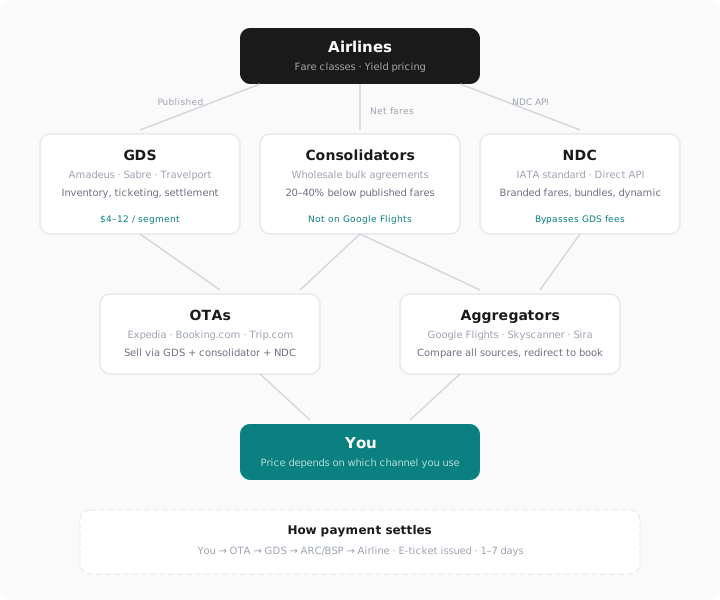
This is why the same United JFK-London flight might show $512 on United.com (NDC direct), $528 on Expedia (GDS + fees), and $465 through a consolidator-connected agent (net fare + markup). The differences aren’t random — they’re structural.
This is why we built Sira differently. Most OTAs layer on consolidator markups, service fees, or hidden charges that make it impossible to know what you’re actually paying for. Sira sells published fares — the same prices airlines file publicly — with no added fees, no markup, and no consolidator games. What you see is what the airline set. Transparent pricing, every time. Search flights on Sira →
Ready to book?
Compare real-time fares across 100+ airlines. No hidden fees, no markup — just the lowest price available.
Search flights on Sira →