
3 Companies Control Every Flight You Book
Amadeus, Sabre, Travelport — three companies power nearly every flight booking on Earth. How money moves from your credit card to the airline, why airlines can't just sell direct like Amazon, and what actually happens when you cancel.
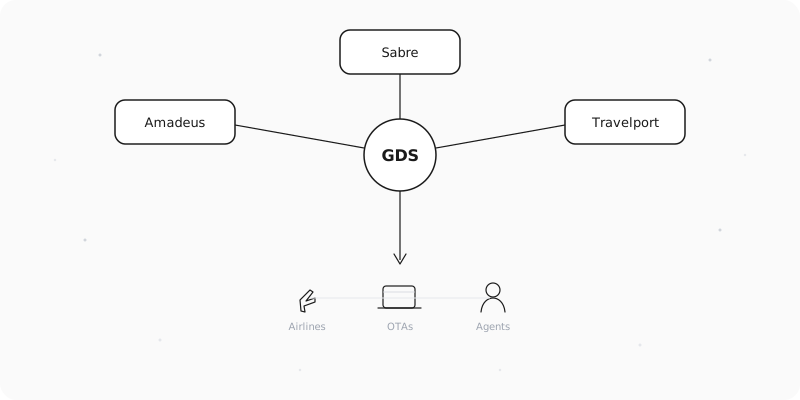
Every time you search for a flight on Expedia, a travel agent’s screen, or most booking platforms — that search is hitting a GDS. You’ve probably never heard the term, but Global Distribution Systems are the backbone of the entire travel industry. Three companies quietly process billions of dollars in travel bookings every year, and most travelers have no idea they exist.
What a GDS actually is
A Global Distribution System (GDS) is a massive, real-time network that connects airlines, hotels, and car rental companies to the travel agents, OTAs, and booking platforms that sell their inventory. Think of it as the central nervous system of travel — a shared database that lets any authorized seller see what’s available and book it instantly.
There are three major GDS providers:
Amadeus — headquartered in Madrid, the largest GDS in the world. It powers roughly 40% of global travel bookings. Most European carriers, OTAs like Booking.com, and hundreds of thousands of travel agencies connect through Amadeus.
Sabre — based in Dallas, Texas. Originally built as American Airlines’ internal reservation system in the 1960s (one of the first real-time computing systems ever created). Today it powers much of the US travel agency market and several major OTAs.
Travelport — operates two legacy systems, Galileo and Worldspan. Strong presence in the UK, Asia, and parts of the US. The third player in a market that’s essentially an oligopoly.
Together, these three handle the vast majority of travel bookings worldwide.
How a booking flows through a GDS
Here’s what happens in the seconds between you clicking “Search” and seeing flight results:
1. Search — You enter your route and dates on an OTA. The OTA sends a search request to one or more GDS systems.
2. Availability check — The GDS queries the airline’s reservation system in real time. It checks which fare classes still have open seats on that specific flight. This happens in milliseconds.
3. Fare retrieval — The GDS pulls published fares from ATPCO (Airline Tariff Publishing Company), the central clearinghouse where airlines file their prices and fare rules. There are roughly 200 million active fares in ATPCO’s database at any given time.
4. Results returned — Available flights with fares, fare rules (change fees, refund policies, baggage allowances), and seat maps are sent back to the OTA and displayed to you.
5. Booking — You select a flight and pay. The GDS creates a PNR (Passenger Name Record) — a six-character alphanumeric code that becomes your booking reference.
6. Ticketing — The GDS issues an e-ticket, identified by a 13-digit number. This is the actual contract between you and the airline. The PNR is your reference; the e-ticket is your proof of purchase.
7. Settlement — This is where it gets interesting. Your payment doesn’t go directly to the airline. The GDS routes the transaction through an industry clearinghouse — ARC (Airlines Reporting Corporation) in the US, or BSP (Billing and Settlement Plan) internationally. ARC/BSP aggregates bookings from all agents and OTAs, reconciles them weekly, and transfers the funds to each airline. Settlement typically takes one to seven days.
How money actually moves through the system
This is the part most travelers never think about. When you pay $500 for a flight on an OTA, your credit card is charged immediately — but the airline doesn’t see that money for days. Here’s the full chain:
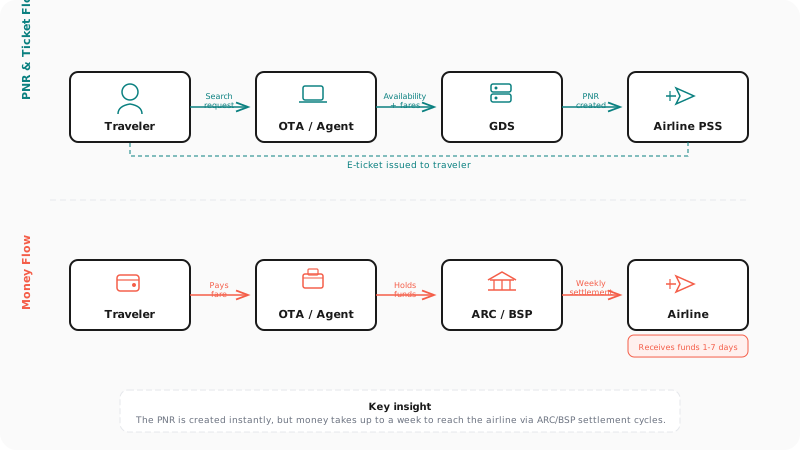
Step 1: You pay the OTA or travel agent. Your credit card is charged by the seller — not the airline. The OTA collects the full fare amount plus any service fees they charge.
Step 2: The seller reports the transaction. The OTA or agent files a sales report with ARC (in the US) or BSP (internationally). This report includes every ticket sold, the fare amount, taxes, and the commission structure. Agents typically file reports on a set schedule — often twice a week.
Step 3: ARC/BSP aggregates and reconciles. ARC collects all sales reports from thousands of agents and OTAs. It reconciles the numbers — matching tickets sold against fares filed, taxes collected, and commissions owed. This is essentially a massive clearing house that handles trillions of dollars in airfare transactions annually.
Step 4: The airline receives funds. ARC/BSP transfers the net amount (fare minus agent commission and GDS fees) to the airline. Settlement cycles are typically weekly. For a ticket sold on Monday, the airline might not receive the funds until the following Monday — or even later for international BSP settlements.
The float problem: During this gap, the OTA is sitting on the airline’s money. This is why IATA and ARC require financial bonds from accredited agencies — if an agency goes bankrupt while holding unremitted funds, the bond covers the airline’s losses. The bigger the agency, the larger the bond requirement. Some large OTAs carry bonds worth tens of millions of dollars.
Credit card chargebacks add another layer. If you dispute a charge with your bank, the chargeback doesn’t hit the airline — it hits the seller who charged your card. The OTA or agent has to fight the dispute, and if they lose, they absorb the cost. Airlines are largely insulated from payment risk in the GDS model, which is one reason they tolerate the fees.
Why airlines can’t just build an Amazon-like direct system
This is the question everyone asks: if GDS fees cost airlines billions, why don’t they just sell everything directly through their own websites? Amazon doesn’t pay a middleman $12 per order. Why can’t Delta do the same?
The answer is that airline distribution is fundamentally different from e-commerce, and the obstacles are structural — not technical.
1. Airlines need third-party sellers to reach customers. Amazon sells its own products (and third-party goods) from a single storefront. An airline sells one product — seats on its flights — but needs to appear on hundreds of booking platforms to capture demand. A traveler searching JFK to London doesn’t go to every airline’s website individually. They go to Google Flights, Expedia, or a travel agent. If United pulled out of all third-party channels, they’d lose the massive chunk of customers who discover flights through those platforms.
2. Corporate travel requires GDS access. Business travel represents 30-50% of airline revenue (and a much higher percentage of profit, since corporate travelers often book premium cabins). Corporate travel management companies (TMCs) like American Express GBT, CWT, and BCD Travel run entirely on GDS systems. Their booking tools, expense management, policy enforcement, and reporting all depend on GDS connectivity. If an airline cut off GDS access, it would effectively cut off corporate travel — the most profitable customer segment.
3. Interline and codeshare bookings depend on GDS. When you book a trip that involves two different airlines (say, Delta to Atlanta and then a partner airline to São Paulo), the GDS handles the interline ticketing — creating a single PNR that spans both carriers. Airline websites can’t easily sell competitors’ inventory. The GDS makes multi-carrier itineraries possible.
4. Revenue management gets more complex without intermediaries. Airlines use sophisticated yield management to price every seat. The GDS distribution model lets them file fares centrally through ATPCO and have those fares appear instantly across every channel. Building direct integrations with hundreds of sellers would mean managing hundreds of API connections, each with different technical requirements, update cycles, and support needs.
5. NDC is the compromise, but adoption is slow. IATA’s NDC standard is the airline industry’s attempt to get the best of both worlds — selling through third parties without paying full GDS fees. But NDC adoption has been uneven. Many travel agents and OTAs haven’t built NDC connections. The technology is less mature than GDS. And airlines that push too aggressively toward NDC-only distribution risk losing bookings to competitors that are easier to book through traditional channels.
The bottom line: airlines are stuck in a system they helped create. GDS companies have deep moats — network effects, decades of integration, and control over the corporate travel pipeline. Airlines can nibble at the edges with NDC and direct-channel incentives, but a wholesale shift to Amazon-style direct selling isn’t realistic for the foreseeable future.
What happens when you cancel: refunds through the GDS
Cancellations reverse the entire booking chain — but the refund path isn’t always the same as the payment path. Here’s how it works:
Voluntary cancellation (you decide to cancel):
The refund you receive depends entirely on the fare rules attached to your ticket. Every fare class has specific cancellation rules filed with ATPCO:
-
Refundable tickets (typically full-fare economy, business, or first class): The airline processes a full refund minus any cancellation fee specified in the fare rules. The refund flows back through the same chain — airline → ARC/BSP → OTA/agent → your credit card. This can take 7-20 business days because each step in the chain has its own processing cycle.
-
Non-refundable tickets (most discount fares): No cash refund. You may receive an airline credit or voucher for future travel, minus a change fee (though many US airlines have eliminated change fees on most fare classes since 2020). Some tickets are completely non-refundable with no credit — read the fare rules before booking.
-
Basic economy tickets: The most restrictive. Often non-refundable, non-changeable, with no credit. The only exception is the US DOT’s 24-hour rule — any ticket can be canceled for a full refund within 24 hours of booking, as long as the flight is at least 7 days out.
Involuntary cancellation (the airline cancels your flight):
This is where regulation takes over. When an airline cancels a flight or makes a significant schedule change:
-
US (DOT rules): Airlines must offer a full cash refund — not a voucher — for canceled or significantly changed flights. As of 2024, DOT defines “significant change” as a departure time shift of 3+ hours (domestic) or 6+ hours (international). Refunds must be issued automatically within 7 business days for credit cards and 20 days for other payment methods.
-
EU (EC 261/2004): Passengers are entitled to a full refund OR rebooking, PLUS compensation of €250-€600 depending on flight distance — even if the airline rebooks you. The compensation is on top of the refund.
-
Canada (APPR): Similar structure to the EU. Refund or rebooking plus compensation of $125-$1,000 CAD depending on the delay length and carrier size.
How the GDS handles void vs. refund:
There’s a critical technical distinction in the GDS:
-
Void — If a ticket is canceled within the same reporting period it was issued (usually the same day), it can be voided. A void completely erases the transaction as if it never happened. No settlement occurs, no refund processing needed. It’s clean and instant.
-
Refund — If the ticket has already been reported to ARC/BSP (typically after the same-day window closes), it must go through a formal refund process. The agent files a refund application, the airline’s system validates it against fare rules, and if approved, the refund amount flows back through ARC/BSP to the agent, who then credits the customer. This multi-step process is why refunds take weeks rather than days.
Chargebacks as a last resort: If an airline or OTA refuses a legitimate refund, passengers can file a chargeback with their credit card company. But chargebacks are adversarial — the merchant (OTA or airline) can dispute them, and excessive chargebacks can damage a seller’s relationship with payment processors. It’s a backstop, not a first option.
Why airlines pay for this — and why they’re trying to leave
Airlines pay GDS companies a booking fee of $4 to $12 per flight segment for every ticket sold through the system. On a round-trip domestic flight (two segments), that’s $8 to $24 per passenger. On a $200 fare, the GDS fee alone can be 5-10% of revenue.
Multiply that across hundreds of millions of bookings and you get the scale: GDS fees cost the airline industry billions of dollars per year. Amadeus alone reported over €5 billion in revenue in 2024.
This is exactly why airlines have been investing heavily in NDC (New Distribution Capability) — an IATA standard that lets airlines connect directly to sellers without going through a GDS. Lufthansa Group added a surcharge to GDS bookings. American Airlines pulled certain fares from GDS entirely. The message is clear: airlines want to reduce their dependency on these middlemen.
What this means if you’re booking flights
For most travelers, the GDS is invisible — and that’s by design. But knowing it exists explains a few things:
Why prices are often identical across sites — Most OTAs query the same GDS and pull the same ATPCO-filed fares. The price on Expedia and the price at your local travel agent are frequently the same because they’re both reading from the same source.
Why some fares only appear on airline websites — Airlines increasingly reserve their best prices for direct channels (their own website, NDC connections) to avoid paying GDS fees. If you only search OTAs, you might miss NDC-exclusive fares.
Why Sira shows published fares with no markup — We believe in transparent pricing. The fare you see on Sira is the published fare the airline filed — no consolidator games, no hidden service fees layered on top. Search flights on Sira →
Ready to book?
Compare real-time fares across 100+ airlines. No hidden fees, no markup — just the lowest price available.
Search flights on Sira →