
There's a Secret Airfare Market Where Flights Are 40% Cheaper
Airlines quietly sell seats at 20-40% below published prices through wholesale companies called consolidators. Here's how the consolidator market works and why those fares never show up on Google Flights.
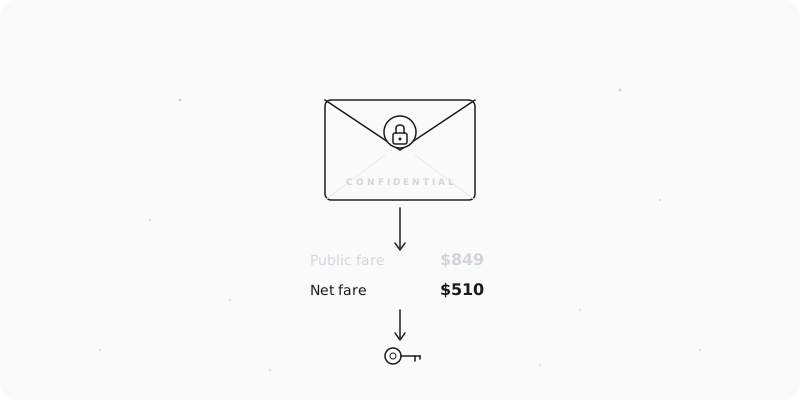
There’s a parallel airfare market that most travelers don’t know exists. While you’re searching Expedia and Google Flights, travel agents are accessing a completely different set of prices — confidential wholesale rates that can run 20-40% below what you see online. The companies that make this possible are called consolidators.
How consolidators work
An airline consolidator is a wholesale travel company that negotiates private, discounted fares directly with airlines. The airline says: “Guarantee us a certain volume of bookings on these routes, and we’ll give you a price below what we publish.”
These are called net fares — the wholesale price before any markup. They bypass ATPCO (the central fare filing system) entirely, which means they never appear on Google Flights, Skyscanner, Expedia, or any public search.
Companies like Centrav operate as consolidators. They sign volume agreements with dozens of airlines covering specific international routes. The airline provides confidential net rates. Centrav distributes those rates to their network of travel agents, who add a markup and sell to consumers. The final price — even with the agent’s margin — is still below the published fare.
Why airlines do this
Airlines face a fundamental economic problem: an empty seat has zero value after the door closes. A plane flying JFK to Mumbai with 40 unsold seats represents pure lost revenue. Airlines would rather sell those seats at a 30% discount through a wholesale channel than not sell them at all.
But they can’t publicly advertise those discounts without undermining their published fare structure. A passenger who paid $900 would be furious seeing the same seat for $600 on the airline’s own website. Consolidators solve this by keeping discounted prices in a semi-private distribution channel — available to travel agents but invisible to casual online searches.
Where consolidator fares save the most
The discount gap between published and consolidator fares varies dramatically by market:
Largest savings (20-40% below published):
- US to South Asia (India, Sri Lanka, Bangladesh)
- US to Africa
- US to South America
- International business class on most routes
Moderate savings (10-20%):
- US to East Asia (China, Japan, Korea)
- US to Middle East
- Transatlantic to secondary European cities
Minimal savings (under 10%):
- Domestic US flights
- US to major European hubs (London, Paris) — these routes are already heavily competed on published fares
The tradeoffs
Consolidator fares aren’t free money. They come with restrictions:
- Often non-refundable or carry heavy cancellation penalties
- Changes may be more expensive or not allowed
- May earn reduced or zero frequent flyer miles (some are booked in specific fare classes that earn fewer miles)
- Seat selection may be limited until check-in
- The ticket is legitimate — issued on the airline’s own ticket stock — but the fare rules differ from what the airline sells directly
Why Sira doesn’t use consolidator fares
We built Sira around a different principle: transparent, published fares with no markup. When you search on Sira, you see the same price the airline filed publicly — no consolidator markups disguised as “discounts,” no hidden service fees added at checkout. We think you should always know exactly what you’re paying and why. Search flights on Sira →
Ready to book?
Compare real-time fares across 100+ airlines. No hidden fees, no markup — just the lowest price available.
Search flights on Sira →